
What is Quarter Sequence?
Quarterly Theory, read in sequence — the nested quarters stacked into chains, the divergence that unlocks them, and why the two must agree before anything is worth your attention.
Quarter Sequence is Quarterly Theory read in sequence: the moments when three or more nested cycles — say the Daily, the 90-minute and the Micro — sit in the same quarter at once. That alignment is a chain, the door; an SSMT divergence inside it is the key; and direction comes from the True Opens, never from the chain.
Quarterly Theory names the parts: four quarters, nested across every timeframe, each with a job. Quarter Sequence is Quarterly Theory, read in sequence — how those parts assemble. Because a quarter on its own tells you very little, but several timeframes sitting in the same quarter at the same moment tell you a great deal.
Quarter Sequence assumes Quarterly Theory. If the four quarters aren't second nature yet, read the foundation first — then come back.
Origins
Quarter Sequence began with the findings of two traders. We've taken it apart in QS Lab, tested it against years of market data, and built on it — here's who they are, before the guide begins.
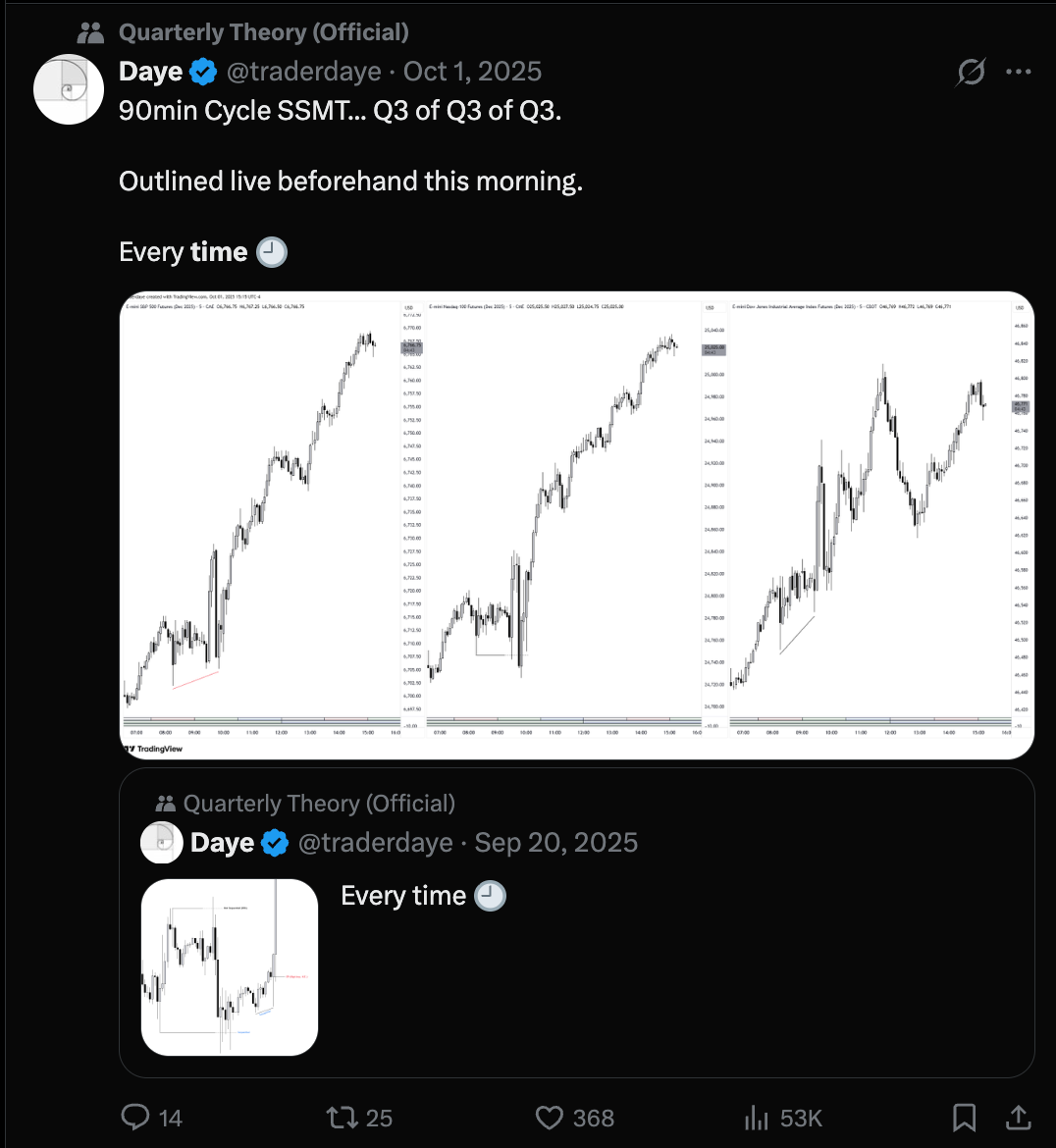
Daye created Quarterly Theory — the four nested quarters that everything here rests on. Here he is on the idea at the centre of Quarter Sequence:
Lethality dug deep into Quarterly Theory and surfaced the refinement he named Quarter Sequence — reading those quarters in sequence, as chains.
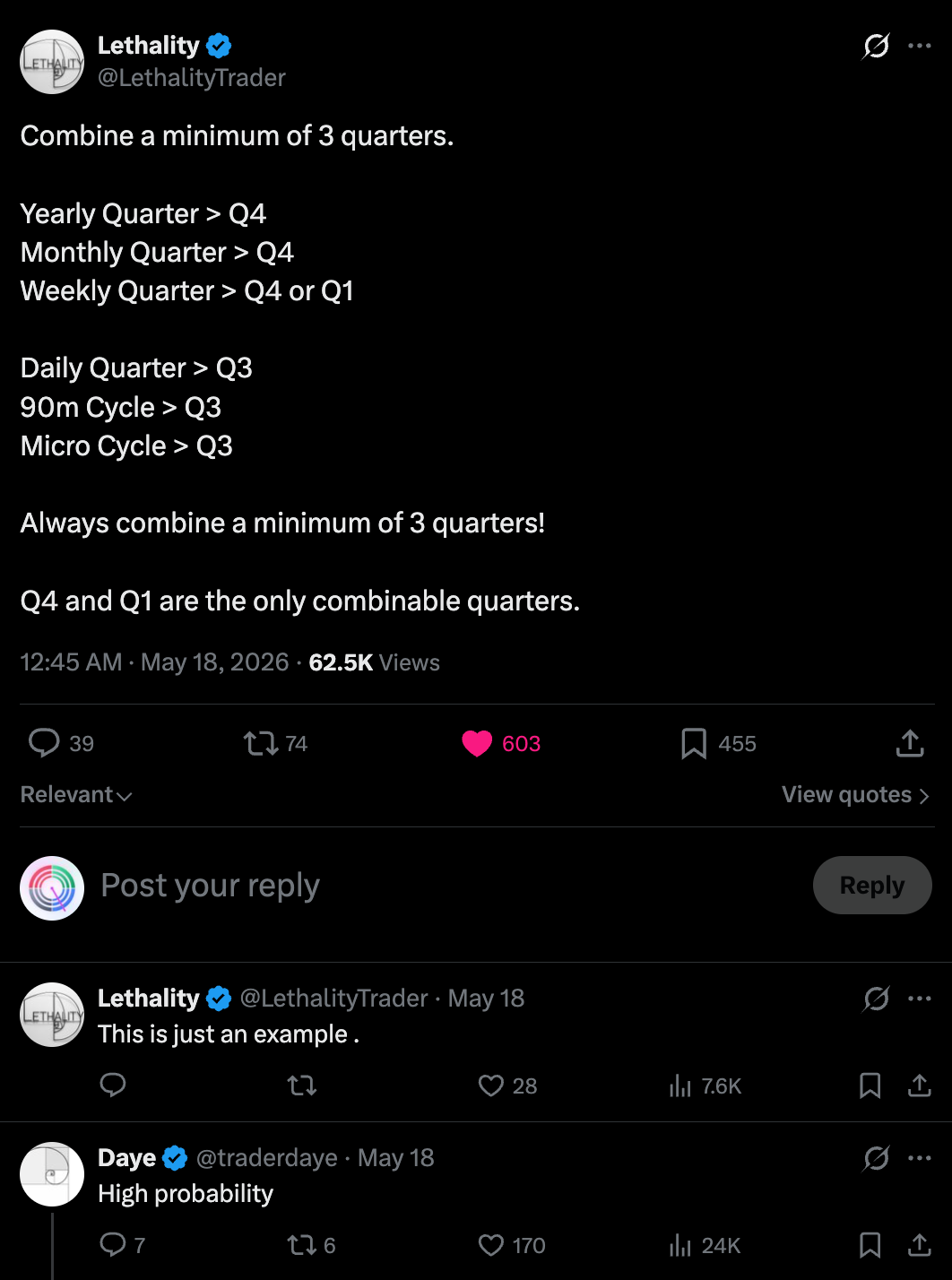
@timexpricex has posted a lot of his own findings on it, too — all of which gave us a basis to begin our own deep research.
What quartersequence.com adds is the pressure-testing: the framework taken apart cycle by cycle and analysed in depth through QS Lab, our private research software, so it has to prove itself on the chart rather than be taken on faith. The concept is theirs; the stress-testing and the indicators are the contribution here.
With the credit where it belongs — let's get into Quarter Sequence.
What it is
If you've read the Quarterly Theory guide, you know our metaphor: quarters are the doors, SSMT divergence is the key. Quarter Sequence is the discipline of reading both sides of that sentence properly — and waiting for a QS SMT.
The sequence in the name is literal. At any moment the market sits in a stack of nested quarters — the Weekly is in one, the Daily in another, the 90-minute and Micro in their own. Most of the time that stack is a jumble: a Daily Q3 over a 90-minute Q1 over a Micro Q4. Nothing aligned, nothing to read.
But a few times a day the stack synchronises — the same quarter number, on several adjacent timeframes, at once. That alignment is the sequence, and it is the precondition for everything else we do.
This is where Quarter Sequence departs from Quarterly Theory. QT will read an SSMT at any quarter boundary — one or two of the triad sweeping the previous quarter's extreme while the rest hold. Quarter Sequence keeps that exact divergence but adds one demand: it only counts when it fires inside an aligned chain — and that is what makes it a QS SMT. Same key; QS just insists there's a real door for it to turn in.
No chain — no door
A chain — an open door
Two rules follow immediately, and they do most of the work of keeping you out of bad trades: a door with no key is noise (an open chain where no divergence prints — nothing confirmed it), and a key with no door is noise (an SSMT divergence firing outside any alignment — a crack in correlation with no delivery window behind it). Only a key turning in an open door is worth your attention.
Why sequence it? — the refinement
Quarterly Theory on its own has one weakness, and it's a strange one: generosity. Every timeframe is always in some quarter, so at any moment a chart offers you a dozen quarter-shaped explanations for whatever just happened. A framework that can explain everything after the fact helps you with nothing before it.
Quarter Sequence is the refinement that closes that gap. It takes the same theory and removes its degrees of freedom, one condition at a time:
- One quarter is not a read. The chain demands a minimum of three adjacent cycles agree — rare by construction. Most of the session there is simply no chain, and therefore nothing to do.
- A chain is not a direction. The True Opens have to give the bias before the door means anything — a second, independent condition.
- Alignment is not confirmation. A key still has to print inside the open door, at the boundary, across the triad — a third.
Each condition throws reads away, and that is the point. What survives is a small number of windows, defined before the fact, at known clock times, with a checkable trigger. That's what a more accurate read means in practice — not a promise about outcomes, but a read precise enough to be wrong cleanly: it either sets up or it doesn't, and you always know which. The theory tells the story; the sequence makes it testable.
It also sharpens time itself. A single Daily quarter is a six-hour window. Stack the 90-minute and Micro cycles into it and the same idea narrows to minutes — you'll see it collapse to a 22-minute window in the walk-through below. The more of the ladder that agrees, the less time and price you have to be wrong in.
The chain — when a door opens
The unit of Quarter Sequence is the chain: three or more adjacent nested cycles sitting in the same quarter, read from the higher timeframe down. Daily Q3, 90-minute Q3, Micro Q3 — a three-deep distribution chain. The market isn't just distributing on one clock; it's distributing on three clocks at once, each nested inside the last.
Why three? One cycle in Q3 is just that cycle's rhythm. Two might be coincidence. Three adjacent cycles synchronised is the market telling you the same story at three scales — and because the cycles are nested, the alignment is also a statement about timing: the smaller quarters sit inside the larger one, so the whole stack resolves together.
And three is the floor, not the ceiling. A four- or five-deep chain — Weekly, Daily, 90-minute and Micro all sharing a quarter — is a stronger read than a bare three: more independent clocks telling the same story. Chain length is a dial. The longer the chain, the higher the probability.
* Advanced — the Nano cycle sits one level below Micro: each Micro quarter splits into four ~5.6-minute Nano quarters.
Two qualifiers matter:
- Adjacent means adjacent. They must be consecutive cycles on the ladder (Daily → 90-minute → Micro). A Daily and a Micro agreeing with nothing in between is not a chain.
- Any shared quarter counts — Q1 included. When all three clocks agree, the door is open, whatever the quarter. A pure Q1·Q1·Q1 alignment is a valid chain like any other; each quarter simply carries its own character — Q1 accumulation, Q2 manipulation, Q3 distribution, Q4 continuation.
And a door doesn't stay open. A chain lives only while every cycle in it still shares the quarter — the moment the lowest-timeframe cycle rolls into its next quarter, the alignment breaks and the door closes. That's why a chain is a narrow window in time, not a mood for the whole session: the lower the cycles stacked into it, the tighter that window. The read is something you act inside, not something you sit in all day.
The one exception — the Q4 → Q1 bridge
Same quarter, top to bottom, is the rule — with exactly one exception. A higher cycle's Q4 may link to the cycle below's Q1 — and vice versa. The reason is the seam: Q4 ends a cycle and Q1 opens the next, so they're the only two quarters that sit side by side across a cycle boundary. The classic case is the hand-off — a higher Q4 completing its reversal while the cycle below already accumulates in Q1 — but the pairing holds whichever way the cycles are nested. Q4 and Q1 are the only two quarters allowed to combine across phases; no other cross-quarter link counts.
Direction comes from True Opens — never from the chain
Here is the mistake almost everyone makes when they first see chains: they read direction into them. A Q3 chain doesn't mean up or down — Q3 is distribution, and markets distribute in both directions. The chain answers when. It never answers which way.
Which way comes from the True Opens — the Q2 opening prices of each cycle, stacked into a bias. Above an open the market can afford to be sold — premium, a short lean, with discount as the target. Below one it can afford to be bought — discount, a long lean, with premium as the target. Price on the same side of two or more opens is our initial bias — the side we lean before a key confirms it.
So the division of labour is strict: the chain is the clock, the opens are the compass. Keep those jobs separate and half of Quarter Sequence is already in your hands.
The key in the door
An open chain with the bias set is still only an open door. The event that unlocks it is SSMT divergence — one asset in the triad sweeping its previous quarter's extreme while a peer refuses to follow. Read across a triad (NQ · ES · YM for index futures), at a quarter boundary, inside the open chain.
Why does the chain make the divergence meaningful? Because the chain says a synchronised delivery window is open — so a crack in correlation inside that window is the algorithm showing its hand at exactly the moment it matters. The same crack at a random 3 a.m. swing is just noise between quarters. That's the whole doctrine in one line: the SSMT is the key, but only a door gives it a lock to turn in.
SSMT has its own depth — standard and hidden variants, lifecycle, invalidation — covered in the SSMT guide. And when a key turns, the entry itself executes on the odd-one-out — the Diverger — a doctrine we'll treat properly in its own guide.
QS SMT — the key, named
The key we've been calling a QS SMT — a Quarter Sequence SMT, an SSMT that fires inside a live chain — is worth naming properly, because it sits at the top of a ladder, and the whole ladder is about time. A plain SMT is two correlated assets disagreeing at a swing, with no time context at all. An SSMT is the same disagreement, but anchored — it only counts across consecutive quarters, so time becomes a filter. A QS SMT is stricter still: the same crack in correlation, but it only counts when it prints inside a live Quarter Sequence chain — three or more adjacent cycles sitting in the same quarter, read from the higher timeframe down. Same crack, three tiers, each one making the divergence prove a little more about when.
SMT
SSMT
QS SMT
That top tier is the one worth waiting for. The chain is a filter, not a bonus: with no open chain, even a clean SSMT is noise — a disagreement with nowhere to go. Inside a live one it reads differently, because a synchronised delivery window is exactly where the market tends to disguise its hand as a crack in correlation — so a divergence there is signature, not coincidence. That is the whole discipline in a line: quarters are the doors, the SSMT is the key, and the door has to be open before the key means anything. A QS SMT is simply that key turning in an open door — the rarest of the three, and the highest-conviction read the framework offers.
Reading one NY morning
Put the pieces on a real clock — Friday 10 July, the morning in the charts below. All times New York:
- 06:00 — the Daily Q3 opens. NY-AM is the trading day's distribution quarter. One cycle in position; nothing aligned yet.
- 09:00 — the session's own Q3 opens. The 90-minute cycle joins: two adjacent cycles now share the quarter. The stack is assembling.
- 09:45 — the Micro Q3 completes it. Three adjacent cycles in Q3: the chain is live, the door is open. This is why the 09:45 window keeps appearing in Quarterly Theory writing — it's the moment the morning's stack synchronises.
- The compass check. Price sits above the True Day Open, the NY-AM session open and the Micro open — premium, on three opens. If the door delivers, it leans down.
- The key. Minutes into the window the divergence prints at the highs — one of the triad sweeps the previous quarter's high while the others refuse to follow. Divergence, at the boundary, inside the open chain.
- The read is complete. The chain said now. The opens said down. The key confirmed it. Everything after that is execution and management — which is trading, not reading, and it deserves its own study.
Notice what the sequence did for you at every step: it told you to do nothing until all three agreed. Most of the edge in this framework is in the waiting it enforces.
And not every open door gets a key — which is the system working, not failing. The door opens at 09:45, you check the compass, and often no divergence prints at the boundary: no key, no trade, a few minutes watched and nothing risked. That's the filter doing its job. And when a key does turn, it can still fail — one asset sweeps the high, its peers hold below theirs, you have the divergence, then price reclaims the level and drives back through it. The read invalidates early, at a level you'd marked in advance. Either way you're wrong cleanly: it sets up or it doesn't, and you know which before you're committed.
Two indicators sit on the chart, doing separate jobs. The SSMT markers are from a separate indicator that's still in early beta — for now it flags only the chain-qualified divergences (the QS SMTs), which is exactly what this read relies on. The ribbon beneath the price is our QS Chains Pro indicator, which draws the quarter stack.
Everything above can be read by hand from a chart with a clock. Read along with this guide on a live chart, and let the framework prove itself to you before anything else.
Common questions
What is a chain in Quarter Sequence?
Three or more adjacent nested cycles sitting in the same quarter at the same time, read from the higher timeframe down — Daily Q3, 90-minute Q3, Micro Q3. The one exception is the seam: a cycle’s Q4 may link to the next cycle’s Q1, in either nesting direction.
What is the difference between Quarter Sequence and Quarterly Theory?
Quarterly Theory names the parts: four quarters, nested across every timeframe. Quarter Sequence reads them together and adds one demand — an SSMT only counts when it fires inside an aligned chain, which is what makes it a QS SMT.
Does a chain tell you which way price will go?
No. A Q3 chain says when — the market is distributing on several clocks at once — never which way. Direction comes from the True Opens: price above two or more reads premium, a short lean; below, discount, a long lean.
What is a QS SMT?
An SSMT divergence that fires while a chain is open — the key turning in a door. It is the same divergence Quarterly Theory reads at any quarter boundary; Quarter Sequence insists there is a real door for it to turn in.
Quarter Sequence provides charting tools and indicators, and teaches a framework - not financial advice, signals, or any promise of profit. Trading futures carries substantial risk of loss.